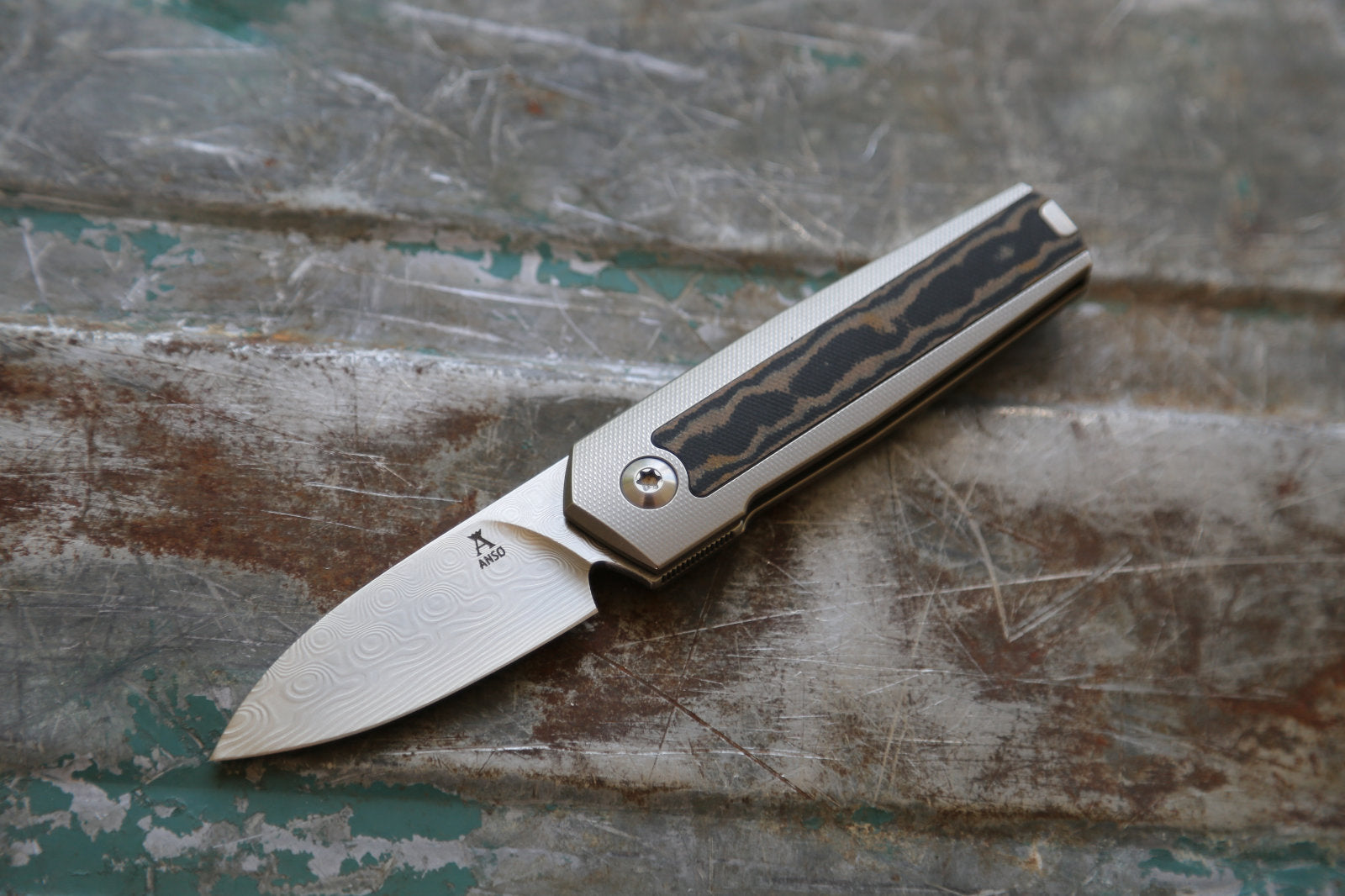
This question falls very close to one of my core beliefs in knife making and something that might ruffle a few feathers.
I have been in this business long enough (this year marks my 25th year of making professionally). For just as long I have been using RWL34 for the majority of my custom knives and now Shop Built knives too.
In those 25 years I have seen super steels come and be praised, only to disappear and be mocked as bad steels shortly after. Often this is due to difficulties working the steel — either sharpening by the end user or grinding and finishing by the maker.
One of the early high-alloy steels was ATS-34, made popular by Bob Loveless back in the 1980s. ATS-34 was pivotal in advancing modern, high-performance stainless knives. To this day I still believe it is one of the great steels out there, if it is even possible to source. RWL34 (named in tribute after Robert W. Loveless) is basically a powder version of ATS-34, with the powder metallurgy giving it a finer grain structure and a purer steel.
When picking a steel for a knife I have three main factors I take into account: edge holding, corrosion resistance, and ease of sharpening. I think RWL34 ranks high in all three categories. There are steels with better corrosion resistance, steels that hold the edge longer, and steels that are easier to sharpen. But choosing any steel is a matter of compromising between what you consider most important in a knife.
Edge holding and corrosion resistance are self-explanatory, but ease of sharpening deserves an explanation. I build tools. Tools to be used and maintained. And because that is so important to me, it is also important that the end user has a fair shot at sharpening the knife themselves. This has also dictated how I sharpen my knives — with a Spyderco Sharpmaker and a leather strop. This is a fairly inexpensive setup that requires little space and hardly any experience to get a good result. The main requirement is an understanding of what you are trying to achieve. This choice also allows my customers to copy my techniques 1:1.
If a steel is so hard to sharpen that people avoid doing it, its theoretical edge retention becomes meaningless.
Soon after Loveless made ATS-34 the go-to steel for his hunting knives, other modern steels appeared. BG42 was one of them, and Loveless would use it, but only for professional hunters who needed to skin several animals in a day, as it held the edge a little better than ATS-34. I think this sums up my own opinion pretty well: is there a need for steels “better” than VG10, Nitro-V, or RWL34 for that matter? By “better” I mean steels that either hold a better edge or are more corrosion resistant. Yes, certainly — but few would actually need it.
Let’s be honest here. I think very, very few can tell the difference between one super steel and another. Even fewer would need whatever that difference is. And let’s also remember that a mediocre steel with excellent heat treat will outperform a super steel with mediocre heat treat. Let’s pretend all knives have excellent heat treat — but in reality they do not.
And to repeat myself: any choice of steel is a compromise between the different areas of performance.
Steel choice matters — but understanding what the knife is actually used for matters more. And one last comment:
steel nerdery is a thing, and it is not necessarily based on rational or practical reasons — but that’s okay too.
Do I think it is a little silly at times? Yes. But so is badminton, and that’s an Olympic discipline.